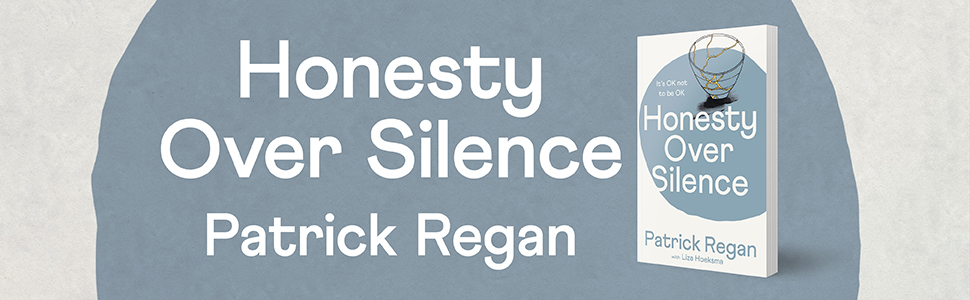

Review of “Honesty over Silence: it’s ok not to be ok”
By Patrick Regan (with Liz Hoeksma)
Last autumn a group of TCF’ers spent a hugely informative, thought-provoking and conversation opening day at the mental health-friendly church day hosted by the church of the Nazarene. I had attended because I wanted to better understand mental health challenges and be better able to help and support people who are dealing with this. I was also delighted to find a bookstall there, and came home with copies of “Brighter Days” and “Honesty over Silence”, written by Patrick Regan, the founder of the charity who were running the seminar – Kintsugi Hope.
That name made sense when it was explained that the charity is named for the Japanese method of repairing pottery with molten gold and so instead of hiding the scars, it makes a feature of them. Patrick Regan founded the charity following his own experiences with anxiety and depression.
“Brighter Days” is a toolkit for mental health and wellbeing; it is personal, helpful and professional and the charity aims to place copies in every waiting room in the UK. “Honesty over Silence” is hallmarked by the same honesty and authenticity. It seeks to break down the conspiracy of silence in our churches (and our wider society) about how hard life can be and how difficult the battles, and lead us on a journey towards hope and healing:
“We can share our own pain, and that in turn helps others to realise they don’t need to be ashamed about theirs.” (p.38)
The book features several testimonies from people who have suffered unimaginable pain and loss, and it is a privilege to be permitted this glimpse into their worlds. The author also shares openly and honestly from his own life and the struggles he has been through in his past, within his family, losses and changes as well as extreme physical pain (he has undergone two major leg surgeries involving wearing a frame for several months.)
Part 1 of the book deals with “letting go”- of inauthenticity, stigma, perfectionism and so on. As a capable, active and altruistic person – a “fixer”, who does not find talking about his feelings easy, it took the author a great deal of courage to acknowledge that he was struggling, let go of shame and embarrassment, and openly share his experiences. He writes of the lies depression will tell people – that it’s all their fault, that they are unworthy of help and that there is no hope. But
“We shouldn’t be afraid of our scars, because a scar is always a place of healing…
I think it’s time that we not only stop feeling ashamed and embarrassed about our pain, but learn to celebrate the beauty of the struggles we’ve been through.” (p.38)
Indeed, if pain is “the crucible in which we will work out our faith” (Sarah Clarkson, 2021), it should be valued and honoured, even as we count our blessings.
As well as letting go of shame, we need to let go of stigma:
“People think that knowing Jesus should mean we’re never depressed, but it doesn’t work that way” (p.62)
According to the mental health charity MIND, one in four people will suffer a mental health problem each year (research from 2018.) We can set ourselves impossibly high standards, burdens that God, knowing our frailty and weakness, never intended for us to bear. The Lord Jesus made it His mission to seek out the oppressed and downtrodden, showing them mercy and compassion. The Bible is very honest with lament, much more than we sometimes are.
“People don’t identify with our strengths; they identify with our humanity.” (p.12, foreword by Christy Wimber)
Perhaps it is about creating an atmosphere where there is space to not feel alone.
We can also show ourselves the same care and compassion as we would a dear friend. Our inner critic, the way we talk to ourselves, can be harsh and unkind. My inner critic is a hard taskmaster, accusing me of lacking compassion and patience and purporting to understand mental health better than I do. But we must silence our inner critic.
Part 2 of the book gently offers us a way forward – “learning to be” – being in community, being honest, being still, being hopeful. We need each other and have more in common than we might think. We need to let go of the idea that there are “those in need” and “those able to help” (p.141). We can all help, and we all struggle in different ways. Empathy is so important and so fundamentally different from sympathy; we want to help people and can say things which may be unhelpful or try to offer solutions, but it can be more healing to simply listen and try to understand. Being involves accepting and living in God’s love, letting His love flow through us.
Being is also living in the moment, “ruthlessly eliminating hurry” (Dallas Willard), and challenging our own thoughts which are often unhelpful and not even reality.
Patrick Regan demonstrates beautiful authenticity and vulnerability. The book is powerful, inspiring and very readable – it is deceptively simple, given the complex nature of mental health and wellbeing. He does not try to offer easy answers for these complex questions, but rather it is an exploration of hope and healing.
Two ideas stood out for me – briefly towards the end of the book, the author describes a change in his life as being like heading out to the wilderness. We have probably all experienced something of this. Other writers have described this image of wilderness as being a place of danger but also of beauty (Eugene Peterson, 1997), a place where God reveals Himself and where He is active – a place where we learn things that cannot be learned any other way.
Darkness is also a concept throughout the book:
“We don’t get to choose when darkness comes into our lives, and we will all face it sooner or later.” (p.26)
The shadows cast by the struggles of life may be long, but God meets us in the darkness and there is hope even in the darkest places. The last chapter, “being hopeful”, explains hope (the second part of the charity’s name) as being not a vague hope that everything will turn out well – that is not the reality of life in this world – but something deeper, a way of thinking. We see the back of the work that is our life with all the messiness and the dark threads in among those of silver and gold, but God loves us and is at work in us weaving a masterpiece.
Article published 30 January 2025